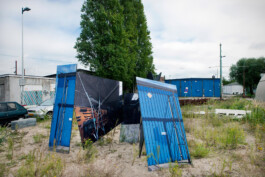
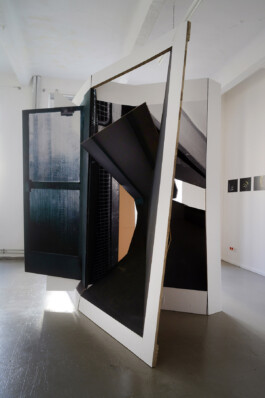
On the periphery of the Schinkel neighbourhood lies the rough Havenstraat area. Everywhere there are sheds of corrugated material where various enterprises and individuals are at work. The activities in these warehouses are invisible. Most are enclosed and have no windows, so it’s impossible to look inside. They are secretive places that arouse curiosity. In the near future this industrial site will make way for a yet to be built residential neighbourhood.On this site Lucia Luptáková has installed a sculpture composed of reflective panels that demarcate a space. The installation reflects its surroundings, is wholly integrated into it and thus almost invisible. Thanks to camouflage, this place might remain unnoticed and survive. Within the installation, the interior of a shed has been recreated using wall-sized photos, taken by Erwin van Amstel. In fragments, what usually remains obscure is now shown openly. Here the physical space crosses over into a mental space; the innards of the dusky shed are like the human subconscious. The work’s title refers to the disappearance of the site as it is currently arranged with all its sheds, as well as to the sculpture as a vanishing point, not merely for the work itself, but likewise for the visitors who can lose themselves within it.
The experience of space is pivotal in Lucia Luptáková’s work. This usually results in large, site-specific installations which people can enter, but recently she has also been working with photography and spatial works to scale.text by Sascia Vos voor KADS 2015.
Location: Kunst aan de Schinkel, Havenstraatterrein, Amsterdam, NL | Year: 2015 | Size: H 260cm x W 300cm x D 280cm | Material: underlayment, iron, acrylic mirrors, blueback posters
Photo poster: Erwin van Amstel
Photos: Gert Jan van Rooij

PLACES OF DISSAPEARANCE
A mirror installation exposing a disappearing industrial site while camouflaging it.


On the periphery of the Schinkel neighbourhood lies the rough Havenstraat area. Everywhere there are sheds of corrugated material where various enterprises and individuals are at work. The activities in these warehouses are invisible. Most are enclosed and have no windows, so it’s impossible to look inside. They are secretive places that arouse curiosity. In the near future this industrial site will make way for a yet to be built residential neighbourhood.On this site Lucia Luptáková has installed a sculpture composed of reflective panels that demarcate a space. The installation reflects its surroundings, is wholly integrated into it and thus almost invisible. Thanks to camouflage, this place might remain unnoticed and survive. Within the installation, the interior of a shed has been recreated using wall-sized photos, taken by Erwin van Amstel. In fragments, what usually remains obscure is now shown openly. Here the physical space crosses over into a mental space; the innards of the dusky shed are like the human subconscious. The work’s title refers to the disappearance of the site as it is currently arranged with all its sheds, as well as to the sculpture as a vanishing point, not merely for the work itself, but likewise for the visitors who can lose themselves within it.
The experience of space is pivotal in Lucia Luptáková’s work. This usually results in large, site-specific installations which people can enter, but recently she has also been working with photography and spatial works to scale.text by Sascia Vos voor KADS 2015.
Location: Kunst aan de Schinkel, Havenstraatterrein, Amsterdam, NL | Year: 2015 | Size: H 260cm x W 300cm x D 280cm | Material: underlayment, iron, acrylic mirrors, blueback posters | Photo poster: Erwin van Amstel | Photos: Gert Jan van Rooijl
SITE IS UNDER CONSTRUCTION
© Lucia Luptáková | planet.lucia@gmail.com